Raja Ram Mohan Roy: The Timeless Indian Reformer

Born in a wealthy family, Raja Ram Mohan Roy would go on to greatly influence the social dynamics and consciousness of Indian society. Ram Mohan Roy was born in Radhanagar, Hooghly District, Bengal Presidency. He was a studious man, mastering various tongues like Sanskrit, Persian, English, Arabic, Latin and Greek.
It was the death of his sister-in-law that would go on to change his entire life. His sister-in-law, at the age of seventeen, met her demise through the ritual of Sati, a practice of burning wives at the top of their husbands’ funeral pyre. Ram Mohan Roy tried to protest against it, but found little success as the screams of the young girl were buried by the chants of ‘Maha-Sati’.
Ram Mohan Roy fought greatly against the evils of Indian society. He founded the Atmiya Sabha and the Unitarian Community to fight social evils, and to propagate social and educational reforms in India. Being influenced by Western education and various Eastern theologies, Ram Mohan Roy campaigns against customs such as Sati, polygamy, child marriage and the caste system. He demanded property inheritance rights for women and in 1828 founded another society, Brahmo Samaj, to fight against social evils.
His campaign against sati was successful as the practice was banned in 1829 by Lord William Bentinck, the then Governor-General of India.
He was also a great believer in education. He set up the Hindu College in Calcutta, with the help of David Hare. Four years later, he founded the Anglo-Hindu School, followed by Vedanta College in 1826. He wanted to bring Western education to Indian society. His weekly journal, Sambad Kaumudi, covered topics like freedom of the press, induction of Indians into high ranks of service, and separation of the executive and judiciary.
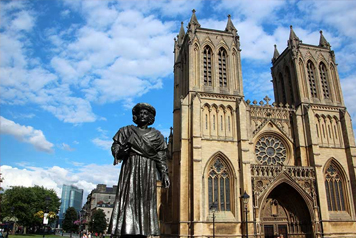
He met his demise on 27 September, 1833 of meningitis or a chronic respiratory ailment. His mausoleum is situated in Bristol, England, where remembrance services are held annually on his death anniversary.
The title of ‘Raja’ was conferred to him by the Mughal Emperor, Akbar II. Sati might have been abolished, but there are various practices and customs which are still harmful, and yet are ignorantly practised to this day. Raja Ram Mohan Roy inspires us to question these rituals and practices and not accept them blindly.